Friday, July 24, 2015

The Airbus A-320 Prodigy


"When you compete with people with reputation and workmanship of Boeing or Douglas, you can't sell aircraft by just doing like them. You have to do better, much better." said Roger Beteille, Deputy General manager of Airbus in 1980's.


And that is what exactly they did. If they had to compete to already successful Douglas MD-80 and Boeing 737, new aircraft had to be designed & manufactured to provide new and original possibilities a.k.a revolutionary possibilities.

A320 family of aircraft is one of the unique stories of aircraft manufactures philosophy of how an aircraft should be. It was the classic example of showing the customers their needs; instead of asking them. The truth is, airline companies don't know what kind of aircraft they want. They had lot of problems which they thought couldn't be solved by just one aircraft. 

Airbus took this behemoth challenge. They were gonna break into a market ruled by competitors and high economic value. If they are to succeed, they had to re-invent traditional concept of commercial aviation.

The A320 aircraft designers started by taking economic concerns of the airline.

It will have a wider and longer cabin that its competitor, meaning more room and comfort for passengers; more space and ergonomics for freight.

The aircraft was developed with two sets of engine which allowed airlines to choose the best for them.

And then there was fly-by-wire. The electric way of flying until then was used in military aircraft. Jean Pierson, the former CEO of Airbus pushed this idea of fly-by-wire to the European authorities until they agreed.

Fly-by-wire turned out to be one of the keystone of the new modern commercial air space. This made the aircraft more safer and easier to control. It also made the way for two an flight deck. 


They also added Composite material for the structure, a fully digital cockpit flight controls making them pioneers of those technology and allowed Airbus to be in the pinnacle of technology.

Before its maiden flight in 1987, A320 received more than 400 orders from 15 airliners around the world. Never before in the history of aviation was there an aircraft received with such enthusiasm. The orders kept on growing during the certification period which ended in February 1988. Just like line of customers in front of apple stores.

In the years to come, airline companies realised with the A320, Airbus was inventing a concept that was perfectly adapted to their needs. 

Then Airbus started its A320 family program. Making the aircraft short and long, the A320 family had tailored solution to airliners problems. Using the same engines, it allowed the airlines to operate in a fluctuating and ever changing aviation market. With the A318, A319 & A321 the Airbus had in fact invented the ultimate elastic aircraft.


What Airbus did with A320 was a calculated risk of changing a traditional aircraft way to fly to a new concept. It was calculated risk but a risk indeed. With the commonality between aircraft, the pilots and spare parts could be swapped for larger operation time and thus making more money for the airliners. 

We owe a lot to Airbus for making this happen. Aviation industry owe a lot to this aircraft. A320 sowed the seeds of innovation which we now take for granted. From 1990 until now- Airbus never stopped innovating with A320. 

The famous sharklets, new engines - all are synced for a brighter future and positive impact. 

By all means Airbus A320 can be called as a legend. An outstanding example of aviation qualities. A Prodigy.


CK


Saturday, July 18, 2015

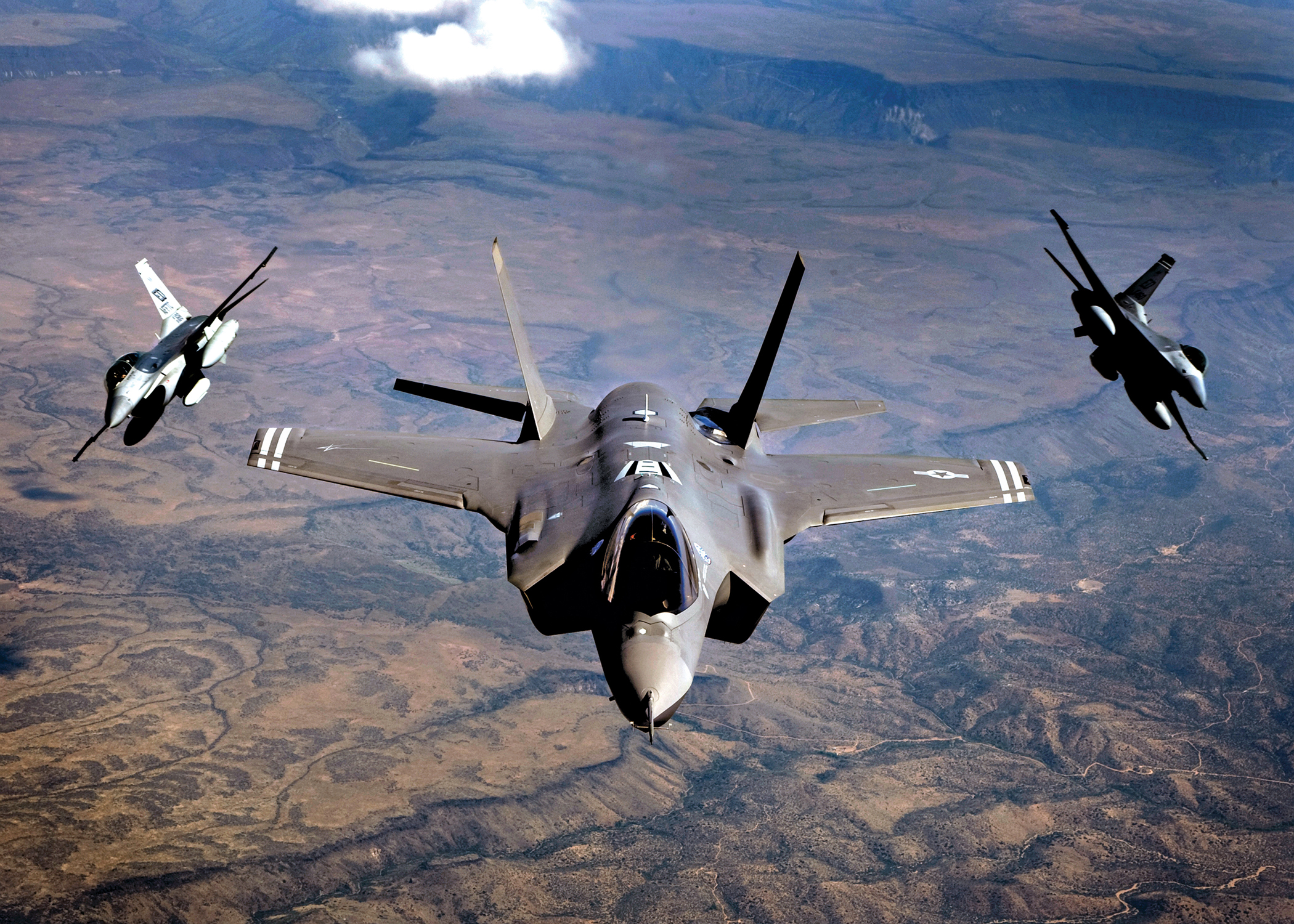
F-35: The most expensive weapon system in World history.


F-35 program which began 15 years ago is one of the most expensive weapon system in the world.

The entire F-35 program cost $200 billion. That is the amount it takes to make "quantum leap" technology. 

With F-35 rolling out soon, defense forces are meeting out a new frontier in military tactics. 

Even when the political pressure is mounting up, aviation enthusiasts are looking forward to see F-35 in action. They are the sentinel of security for the years to come.

Cheers

CK

Friday, July 17, 2015

Personalization & Commercial Aviation

With internet of things (IoT) on the rise, commercial aircraft manufactures are begging to tap into that market.

With IoT, physical objects are able to communicate with each other. As a passenger, this allow personal flying experience.

The architecture of this system is so vast in aviation that designers are bewildered with where to start.
Companies like Boeing and Airbus have always been trying to get more personal with passenger comfort. 

Airliners are particularly interested in how they can give better flying experience to their passengers. Boeing 787 come with various lighting scheme as per passenger mood and comfort. Airliners like Virgin Atlantic have gone far enough to get personalized bar in aircraft - so as to satisfy its customers.


World as we know it now is going for personalization. Everything comes with various features and benefits in order to make sure that the customers get to choose accordingly.  Look around for the millions of mobile apps. Look around for the millions of food joints. Look around for millions of customization services and products.

World is going for long tail model. So will commercial aviation. Commercial aviation is in the verge of evolving into something more than just flying from point A to point B.

With that warm thought in mind, this is CK signing off and you're reading theaviationbusiness.com.

Cheers
CK

Saturday, July 11, 2015

Why do we need two pilots in a commercial aircraft?


Quite simple actually, its because of safety.

In various industries a concept called redundancy is quite common. In aviation redundancy is a household concept. It basically means having Plan A and plan B.

All the systems in commercial aircrafts are designed in this fashion. If one fails, the other takes over. It's a neat setup when you think about it.

Millions of dollars are spent on making this happen. Unlike cars, aircraft designers make sure to minimize technical dis-functionality.

When technical errors are low; the only thing left are human errors. The error a pilot do unconsciously can have disastrous results. Such is the case we have been witnessing with crashes in the last decade.

In order to reduce human errors, a second conscious is kept. Having two brains in the cockpit is better than one and so is the reason why we have two pilots in commercial aircrafts.

Until next time.
Stay cool.
Cheers.

CK

Friday, July 10, 2015

Vortex Generators: Amazing Tiny metal pieces

It's the second week of the month. Today it's design tactics used in aircraft.

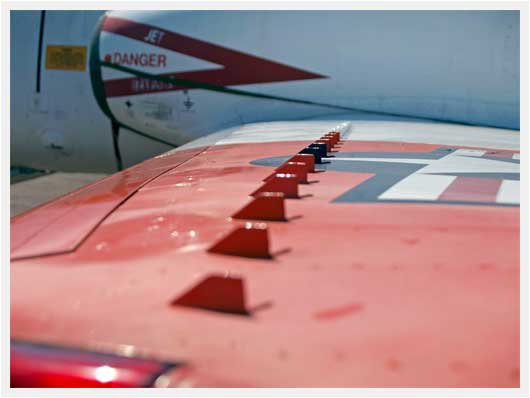
I will discuss about vortex generators. Vortex generators are simple but powerful devices. It's nothing but coin sized metal piece fixed at specific points on the wing. 

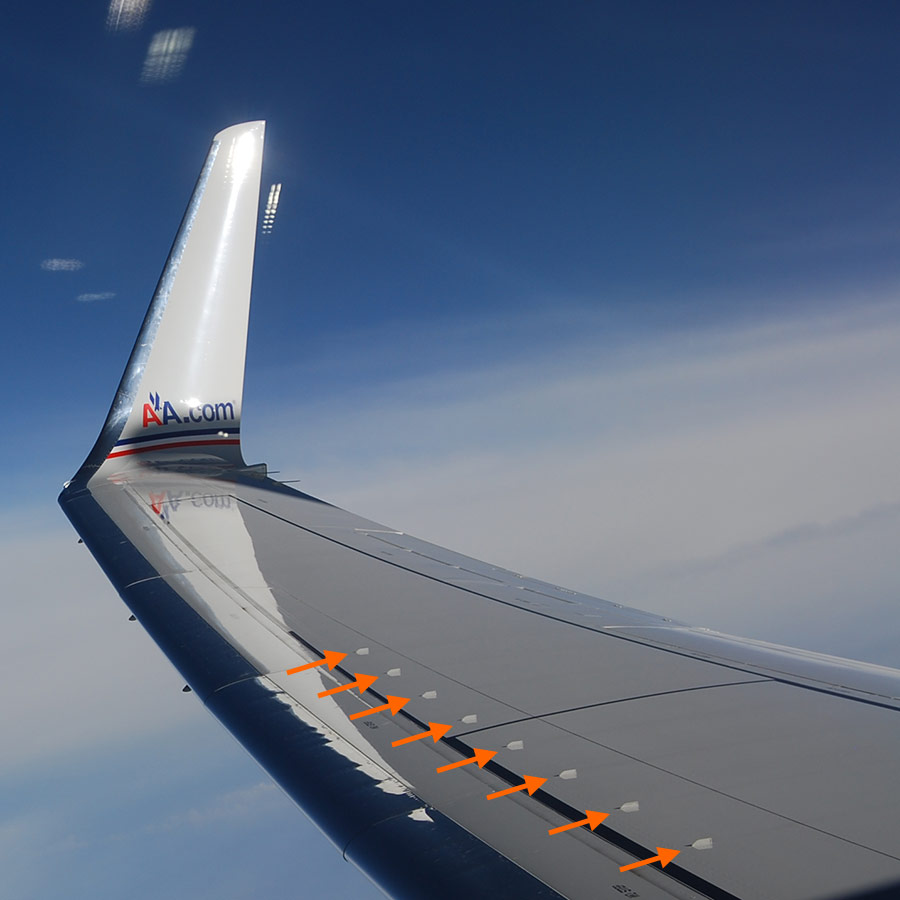
Next time when you go on a trip, try yo find one these on the wings : 


These tin metal pieces are called Vortex  generators. They induce vortex to increase the energy of the stream flow. In simple terms, they make the air to work more.

How does that work? Well, you see the Winglets at the end of the wing tip (AA.com is written on it) - the vortex generator does the exact same thing - in a smaller scale.


Usually there are groups of it kept in a certain pattern. It's astonishing that how such small implementation can make big difference.


Mainly these are used to increase the stall speed, to attain maximum take off weight and reduce noise. 

Great part about this implementation is that; there are companies that provide vortex generators. When you have a specific requirement like minimum take off speed or maximum take off weight; these additions come in great hand. 

Check out this article from boldmethod.com for more : http://www.boldmethod.com/learn-to-fly/aerodynamics/vortex-generators/

Alright Guys.

Stay Cool.

Cheers.

CK


Saturday, July 4, 2015

New Plan. Fresh Schedule.

Here we go!

As promised, below given are the different category or "theme" for future posts:

1. Latest trends, business or technology.

What is latest in aviation. I mean, it's a big industry. Things can be over looked.  We make sure we find the right stuff and post it in our blog. 

2. Contemporary. 

Where are we headed? Will the industry flourish? What is happening now? With this section we write about the current status.

3. Design Tactics.

What is Boeing doing with that sharklet? Why is Airbus 350 wings designed like that? We will go through the brilliant design tactics implemented. 

4. The Why and How?

How can an Boeing 787 take-off like that? Is it real? What are those shiny metal things under the wing? We post about the burning questions about the science behind flight. 

5. Commercial Market

What are the giants upto? Which airctaft is selling more? Why is the new roll-out delayed? We take a look at the commercial space where billions fly around.

6. Defense Market

Where is F-35? How much money is spend in that bomber? We look at the exciting defense market where blowing up stuffs is the day - job.

7. The Legends

You think Concorde is better then Tu-144? In here we write about the legendary flying machines. Enough said.

8. Stories from the past

Why US build a plane worth 2 billion dollars? Exciting stories from the past. Study the history, respect it; so that we can create a better future. 

That's it. Those are the 8 categories. As I said, I will analyse the articles and as per feed back, we can evolve.

As per schedule, I will be posting fresh content on both Friday and Saturday.

A month has 4 weeks, so I am planning to share  ≥ 8 articles per month.

Below given are the posting schedule:

Week 1
  1. Friday - Latest trends, business or technology. 
  2. Saturday - Contemporary. 
Week 2
  1. Friday - Design Tactics. 
    1. Saturday - The Why and How. 
    Week 3
    1. Friday - Commercial Market. 
    2. Saturday - Defense Market. 
    Week 4
    1. Friday - The Legends. 
    2. Saturday - Stories from the past.
    All right.

    All that is left now is execution. Stay tuned. I will see you next Friday.

    Cheers,

    CK


    Friday, July 3, 2015

    New Strategy

    Here we are, ready to reinvent theaviationbusiness.


    But how do someone re-invent something?


    We look back into the basics. We look back what it took us to invent in the first place.


    When Alexander Graham Bell invented the first practical telephone, the sentiment behind that was so connect to loved ones miles away. That was a necessity. Fast forward many, it took Steve Jobs to re-invent how phones are perceived and used for the same sentiment - to connect to loved one.


    I started this blog because I love aviation. I wanted to share my thoughts, that's all. I wasn't taking it serious. I just blogged whenever "the mood" came. I didn't have any plans, schedule or even real content. Just an impulse to express and share.


    With the passage of time, I slowly realized that this is bigger than me. I shouldn't be selfish and careless about this. This is something I am creating for the world, however small it may seem. This is for people who love aviation. I am honored to serve an audience of awesome people like this.


    But I can't do it with the current "impulse" plan. I need to change how things are done. To change, I need a new strategy, scheduled plans and then execute it. And I'll iterate the process; until you are satisfied.


    So, what is our new strategy?


    Focus on your needs. We write about what you want. We set a list of categories and assign them a day. We start to share the post in social medias. We analyse the each category popularity and focus on them.


    This is our new strategy. Now there is lot of work to be done. And so, posting a day per week wont suffice.


    Today, I officially announce that we will posting on two days per week now.  Friday & Saturday.


    Tomorrow I will lay out the categories and schedule.


    So until then take care my friends.


    Cheers.


    CK